DSCR Prepayment Penalties: How They Work (and What to Ask Before You Sign)
A DSCR prepayment penalty is a fee you owe if you pay off the loan early, by selling or refinancing before the penalty period ends. It usually follows one of three structures: fixed, stepdown, or interest-based. Conventional investment loans typically don't carry one. Get the exact schedule in writing before you commit.
A DSCR (debt-service coverage ratio) loan is approved primarily on the property's rental income rather than your personal income. If you're moving from conventional financing to a DSCR loan, the prepayment penalty is one of the biggest differences to understand before you sign. This guide covers what these penalties are, why they exist, how each structure works, and how they affect your plans to sell or refinance.
Key Takeaways
A prepayment penalty is a fee owed when you pay off a loan early, protecting the expected interest income of whoever owns the loan.
DSCR loans commonly carry prepayment penalties. Conventional investment loans typically do not.
Three structures are common: fixed, stepdown (declining), and interest-based.
A stepdown penalty gets smaller each year, so the cost of exiting falls the longer you hold the loan.
Shortening or removing the penalty period is usually possible, but it tends to cost more elsewhere in the loan.
Ask for the penalty schedule in writing before you commit, then test it against your expected hold period.
What is a prepayment penalty on a DSCR loan?
A prepayment penalty is an amount you owe, on top of the remaining principal and accrued interest, when you voluntarily pay off a loan before the date your loan documents specify. On a DSCR loan, that payoff usually means selling the property or refinancing into a different loan. You'll also see it called a prepayment premium or PPP.
The word "premium" is useful here. It isn't a punishment. It compensates whoever owns the loan for income they were expecting to receive.
This is a real difference from conventional lending, where paying a loan off early is normal and costs nothing beyond the payoff balance. The Consumer Financial Protection Bureau describes prepayment penalties as fees some lenders charge for early payoff, typically tied to a full payoff within a set window of a few years, and notes that not all mortgages have one (CFPB).
Why do DSCR lenders charge prepayment penalties?
Most DSCR lenders don't keep your loan on their own books. They fund it, then sell it to investors who buy the right to your payments over the full term. When you pay off early, that expected stream of interest disappears, and the investor is left holding cash they must redeploy at an unknown future rate.
The penalty protects that promised income. The loan is priced and placed as a specific investment, so the prepayment structure makes the loan's owner whole when you leave early.
Conventional loans work differently. Fannie Mae's Selling Guide, for example, makes loans subject to prepayment penalties ineligible for sale to Fannie Mae (Fannie Mae Selling Guide, A3-2-02). That's why conforming conventional loans typically carry none. Some portfolio lenders and other loan types can differ, so always confirm in the loan documents.
The three types of prepayment penalties
Each structure prices the same risk differently. A single loan carries one of them, spelled out in the loan documents before you commit.
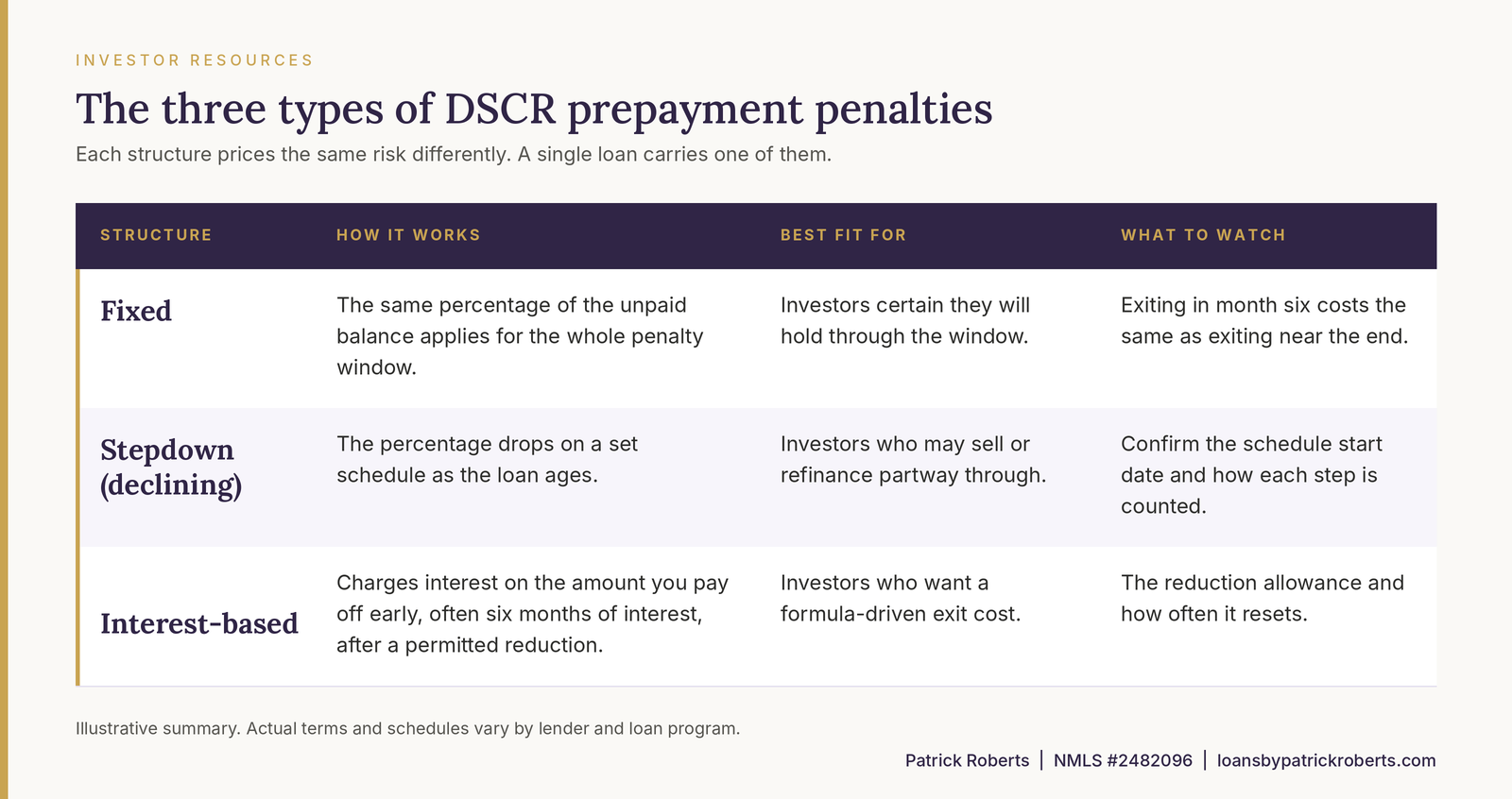
Fixed penalty. You owe the same stated percentage of the unpaid balance no matter when, within the window, you pay off the loan. It's simple to calculate, but it gives you no relief for holding the loan longer.
Stepdown penalty. The percentage falls on a set schedule as the loan ages. A common arrangement is a five-year schedule that drops by one step each year. It rewards you for staying, and it gets steadily cheaper to exit as time passes. Lenders often use shorthand like "3-2-1" to describe a three-year stepdown schedule.
Interest-based penalty. Instead of a flat percentage, this structure charges interest on the amount you pay off early. A common residential DSCR formula is six months of interest on the amount prepaid, and many lenders allow a reduction of up to 20% of the original principal before the interest is calculated.
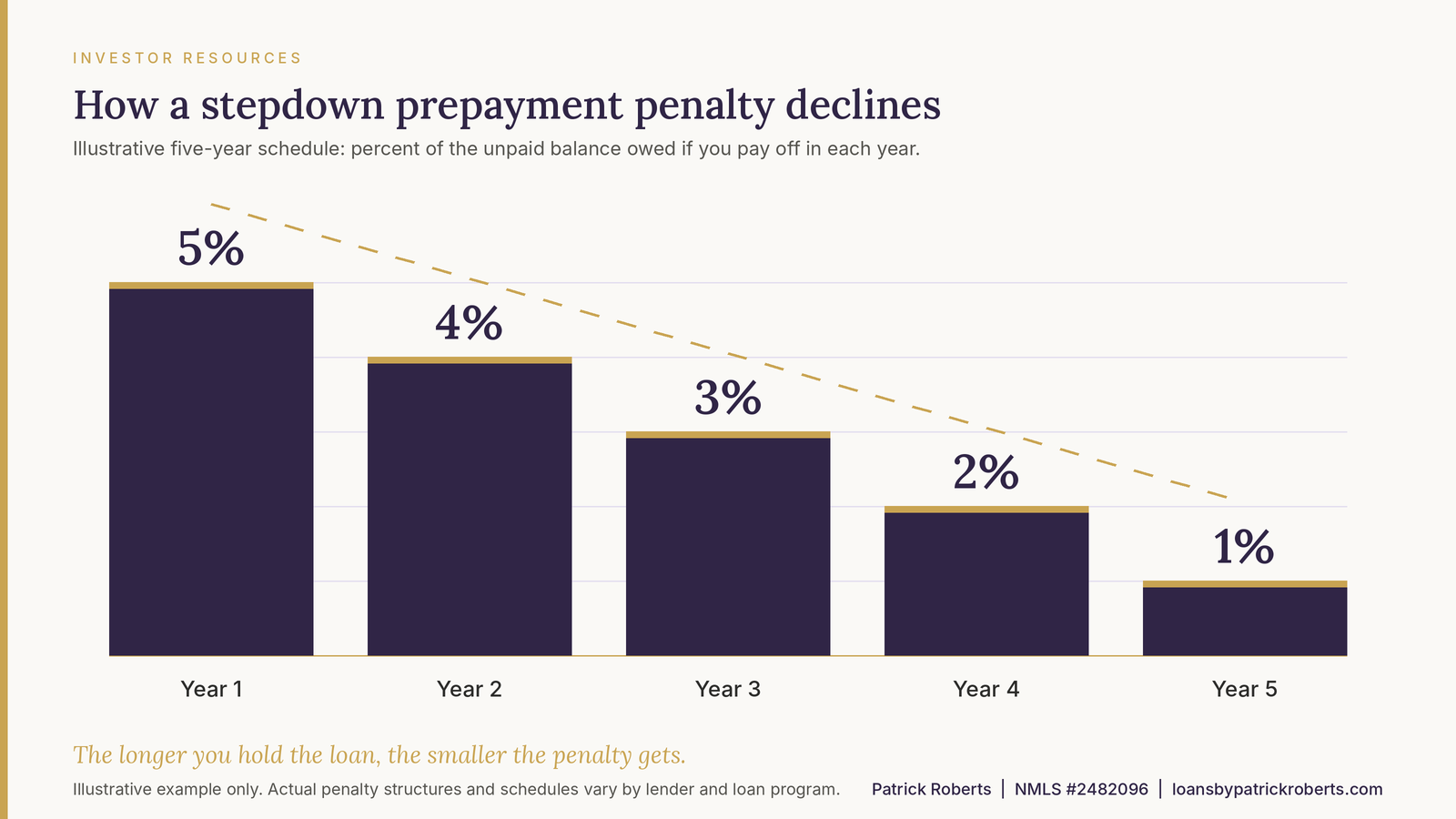
Illustrative example only. Actual penalty structures and schedules vary by lender and loan program.
What is the difference between a hard and a soft prepayment penalty?
A "hard" penalty applies whether you sell or refinance. A "soft" penalty typically applies to a refinance but is waived if you sell the property. Not every program offers both, and the definitions can vary by lender, so confirm exactly which events trigger the penalty in your loan documents.
How is a prepayment penalty calculated?
Two inputs drive the math: the penalty type and the unpaid principal balance when you pay off. For fixed and stepdown penalties, the formula is the stated percentage multiplied by the outstanding principal. No market variables are involved.
For an interest-based penalty, take the amount you prepay, subtract 20% of the original balance, multiply the remainder by your loan's interest rate, then divide by two. In short: (amount prepaid - 20% of the original balance) x your rate / 2.
You won't see the exact figure until you request a payoff statement from your servicer. It shows the remaining principal, accrued interest, and the prepayment premium separately, so you can compare each line to the structure in your original loan documents.
How a prepayment penalty changes your exit plan
A prepayment penalty changes how and when you should sell or refinance. Many investors don't realize that refinancing into a lower-rate loan can trigger it. Running the penalty against your expected timeline before you take the loan can prevent an unpleasant surprise.
If you may sell within a few years, a stepdown penalty that keeps shrinking is usually a better match than a fixed penalty that stays flat.
If you plan to refinance as soon as the property appreciates, weigh whether the penalty will eat the savings a refinance is meant to produce.
If you want maximum flexibility, you can choose a shorter penalty period or none at all, but that typically comes with higher loan costs, a higher interest rate, or both.
Hypothetical example (for illustration only; not based on any specific borrower or loan): An investor expects to hold a property about two years, then sell. A flat penalty would apply the same cost at month 24 as at month 6. A stepdown schedule would have already begun to decline by then. The investor's real decision is not which loan "has a penalty," but which structure fits the hold period they actually expect, and what they would give up elsewhere in the loan to shorten it.
Questions to ask your lender before signing
Most investors are used to loans they can leave at any time, so the penalty is often the last thing they inspect. It should be among the first. Ask your lender for the exact terms in plain language, not buried in the note:
Which structure applies: fixed, stepdown, or interest-based?
How long does the penalty period last, and when does it start counting?
Does a sale trigger it the same way a refinance does?
Are there any penalty-free periods or exit allowances?
Can I make extra principal payments without triggering it?
What would my payoff look like if I exited in year one?
What would a shorter or no-penalty option change elsewhere in the loan?
A penalty that sounds small as a percentage can still be a meaningful dollar amount on a large balance, which is why running your own payoff scenarios matters.
The trade-off: penalty versus flexibility
The prepayment penalty isn't a flaw to avoid at all costs. It's part of the price of the structure that makes DSCR loans available. Because the lender can count on the income stream, they can offer a loan that approves on property income rather than your personal income documents.
The trade-off is real, though. DSCR still requires solid credit, reserves, and a real down payment, and the penalty is the cost of leaving early. You aren't being misled when a DSCR loan carries one. You're being asked to make a different economic commitment than a conventional loan asks.
So the honest framing is a choice. If you want maximum flexibility to refinance or sell whenever you choose, and you qualify on your personal income, a conventional investment loan may fit better. If you want approval based on the property's income and are comfortable holding the loan for its planned term, the penalty is the fair price of that structure. Knowing which one you're buying is the difference between an informed decision and an expensive surprise.
I'm a mortgage broker, which means I work with multiple lenders. Penalty structures and the options to reduce them vary by lender, so a broker who handles DSCR loans regularly can compare which lenders offer which structures and reduction options against your plan.
Frequently asked questions
Do conventional investment loans also have prepayment penalties?
Typically, no. Conventional loans that follow Fannie Mae or Freddie Mac guidelines generally don’t carry them.
How long do DSCR prepayment penalties last?
It varies by lender and program. Five years is the most common term, but shorter periods exist. Confirm the exact period in your loan documents.
Does selling trigger the penalty the same way refinancing does?
Often yes, but it depends on whether the loan has a hard or soft structure. Confirm in writing before signing.
Can I make extra principal payments without a penalty?
It depends on the loan. Many loans allow modest extra payments, while a large lump-sum payment can trigger the penalty. Ask what your loan treats as a prepayment.
Are prepayment penalties always a large dollar amount?
Costs vary by lender and structure, so ask for the exact schedule in writing. A penalty is usually a percentage of the unpaid principal balance, so the loan size is often a factor as well.
Can I shorten or eliminate the penalty period?
Yes, but it usually increases cost in other ways. A period shorter than the most common term typically raises the origination fee or points, the interest rate, or some combination of the two.
Is a DSCR prepayment penalty negotiable?
Sometimes. You can usually choose among structures and periods, and each option is priced differently. Which options are available depends on the lender.
Does a prepayment penalty make a DSCR loan a bad choice?
No. It makes the loan a different commitment. The right answer depends on how long you expect to hold the property and how much flexibility you need.
Next Steps
If you're weighing a DSCR loan against conventional financing and want to see how the penalty fits your hold period, send me your scenario and a rough exit timeline. I'll walk you through the trade-offs.
Related reading: One Deal, Three Quotes | Investor Resources
This article explains how prepayment penalties are structured and calculated. It is educational content, not a rate quote or a commitment to lend. Loan terms vary by lender and borrower qualifications, and I do not quote rates, fees, or return figures here by design.
Sources
Roberts Lending Group, powered by Home Loans Inc
Patrick Roberts | Mortgage Loan Originator | NMLS #2482096 | Licensed in SC, NC, and LA
Home Loans Inc | Company NMLS #1728740
2557 Ashley Phosphate Rd, North Charleston, SC 29418 | Equal Housing Opportunity
loansbypatrickroberts.com
This content is for educational purposes only. It is not a rate quote, loan offer, or commitment to lend. Loan products, terms, and availability vary by lender, borrower qualifications, and property, and are subject to underwriting approval. Home Loans Inc is a mortgage broker, not a direct lender. Not all products are available in all states. Verify our licensing at NMLS Consumer Access.
© 2026 Roberts Lending Group. All rights reserved. | Privacy Policy | Contact