Do DSCR Loans Really Stay Off Your Credit Report and DTI?
The pitch sounds almost too good: get your DSCR rental loans in an LLC, keep them off your personal credit report, and borrow again while protecting your debt-to-income ratio. The first half of that is true - a DSCR loan to a business entity commonly doesn't land on your consumer credit file. The second half is as much myth as reality. When you obtain a DSCR loan through an entity, you are commonly required to agree to a personal guaranty of the loan as the owner of the entity. Understanding how this can affect future loans - and when you are legally required to disclose it - is the difference between successful future borrowing and committing fraud.
KEY TAKEAWAYS
In most cases of a DSCR loan to an entity, one or all of the owners must personally guarantee the loan. This creates a contingent liability.
A DSCR loan to an entity generally stays off your personal credit report, so your credit score itself isn't impacted - but that's not the same as the debt not mattering as a contingent liability.
Underwriters find entity debt through bank statements, tax returns, and business debt schedules even when it never touches your credit file.
Many loan applications require you to disclose any debts, guarantees, or obligations, whether or not they appear on your credit report; deliberately concealing them is fraud.
How a contingent liability is treated in your DTI depends on the loan type - conventional, FHA, VA, and DSCR programs all handle them differently.
Honest disclosure is both a legal requirement and a strategic choice: it protects your borrowing capacity and your reputation for honesty.
Definition
DSCR stands for debt-service coverage ratio. A DSCR loan is a rental-property mortgage (or deed of trust) underwritten on the property's rent relative to its loan payment, rather than on your personal income. It's common for an LLC or other business entity to be the borrower on the note, which is why it typically does not appear on your personal consumer credit report; however, it's also common for DSCR loans to entities to require a personal guaranty by the owner(s).
Why Your Credit Report Isn’t Affected
A DSCR loan to an LLC is a business debt, and consumer credit bureaus generally report only what they are told about individual borrowers (a natural person). If the entity - not you personally - is the borrower on the note, the lender typically has no consumer account to report on your consumer profile. So your credit score and your personal tradeline history stay untouched, which is exactly why the idea of "hidden debt" feels plausible.
That clean report is real and has a genuine benefit: DSCR loans to an entity generally don't add accounts that make a consumer lender wince and can help protect one's credit score. For an investor who wants to keep qualifying for traditional loans on W-2 income and DTI, the structure is legitimate and useful. The problem starts when you assume the absence from the credit report means the debt doesn't matter.
Most DSCR loans to entities require a personal guaranty from a majority owner (member, partner, etc.) for the loan. If the entity fails to pay the loan as agreed, the lender can call upon the guarantor to make payment on the entity's behalf. This circumstance, where an individual could be called upon to pay the entity's loan, is called a contingent liability. So, even though the entity is technically the borrower for the loan, the entity owner(s) are still on the hook for repayment. While loans to entities without a personal guaranty (called "non-recourse") exist, they're unusual in most rental property financing deals.
The URLA and the Legal Duty to Disclose
Here's where the myth goes from tactic to pitfall. Contingent liabilities generally must be disclosed when lenders ask, and most of them will ask. The Uniform Residential Loan Application (URLA) - the standard application form used in nearly all consumer mortgages and known as FNMA Form 1003 - asks you directly about your liabilities and obligations. The form's Section 2, Financial Information, collects your outstanding debts and other financial obligations, and Section 5, Declarations, asks specific questions about your related financial history and how the property will be financed.
Section 5 of the standard URLA is where the disclosure duty lands. In Section 5b, question F, the borrower must answer whether they are "a co-signer or guarantor on any debt or loan that is not disclosed on this application" - the exact prompt that catches a personal guaranty of a DSCR loan to your entity, even though it never appears on your consumer credit report.
The key point is that these questions are not limited to what shows on your credit report. Fannie Mae's own instructions for completing the URLA describe Section 2 as collecting information about "your financial assets, personal financial obligations, and debts you owe" - a broad category that includes guarantees and obligations for loans to any entity you own (Fannie Mae URLA Instructions[1]). If you have personally guaranteed an entity-held DSCR loan, or if the loan is structured such that it creates a contingent liability, that obligation belongs on the application even though it never appears on a consumer credit file.
Why concealment crosses into fraud
When you sign the URLA (or any loan application), you are attesting to your honest disclosure under civil and criminal penalty. Deliberately leaving off a debt, guarantee, or obligation you know you have - because you hoped the lender wouldn't find it - is not a loophole; it's fraud. Mortgage fraud is defined as the intentional misstatement, misrepresentation, or omission relied on by a lender to fund a loan, and it carries serious consequences: a denied application, an acceleration ("calling due") of the loan, and referral to state or federal authorities for criminal prosecution (that can include both fines and imprisonment). Business-purpose loans like DSCR loans frequently have similar requirements, under which failure to disclose financial obligations is a breach of contract and may result in lawsuits against you or an event of default on any new loan.
How Would They Find Out if I Didn't Disclose?
Some borrowers unintentionally forget that they have personally guaranteed a business loan, while others choose to forget they guaranteed a loan. So how would a lender find out?
Where the paper trail lives
When you apply for a consumer loan (and many business loans), you hand over several categories of documents that expose entity debt even when your credit report never mentions it:
Bank statements. Statements routinely reveal transfers to and from an LLC's account, payments to a mortgage servicer or lender, or consistent "mortgage-size" payments during the first fifteen days of each month. A trained underwriter sees those transactions and then requires documentation to verify what they're for.
Tax returns. If you own 25% or more of the business, most mortgage programs treat you as self-employed and pull your personal returns plus the entity's returns and/or K-1. Mortgage interest on Schedule E, entity interest expense, and the debt itself all sit in those filings.
Business financial documents and schedules. Many lenders require a statement of outstanding entity obligations, personal financial statements, a debt schedule, and/or a schedule of real estate. Even when they do not, the entity's financials show interest paid or properties held on the balance sheet, prompting more underwriting questions.
Identity Verification and Fraud Prevention Services. Most lenders obtain third-party background reports for the purpose of verifying a borrower's identity, detecting fraud, preventing terrorism financing and money laundering, and other reasons. These reports compile most publicly available records (like mortgages, deeds, and entity documents) and show any entities, properties, mortgage/loan/UCC filings, and court cases associated with a borrower.
How Different Loan Products Treat Contingent Liabilities
Once the contingent liability is on the table, where it lands in your debt-to-income (DTI) calculation depends on the product you are pursuing. DTI is the ratio of your recurring monthly debt payments to your gross monthly income, and it's the number that a consumer lender uses to determine whether you can afford the loan. The same DSCR payment can be excluded, counted at face value, or counted on a reduced basis, depending on the loan.
Fannie Mae's Selling Guide directs lenders that for each liability they must determine the unpaid balance, the repayment terms, and the payment history, and that they must verify any other liability not shown on a credit report by obtaining documentation from the borrower or creditor (Fannie Mae Selling Guide, B3-6-01[2]). The guide also requires separate credit verification whenever a significant open debt on the application lacks a reference on the credit report and states that if additional liabilities are discovered during underwriting, the lender must rework DTI.
For conventional loans, Fannie Mae's guide indicates that when a contingent liability exists (such as with a personally guaranteed business loan), the lender must confirm it was actually paid out of company funds for the past twelve months and factored into the business cash flow analysis. Additionally, there cannot have been any delinquent payments on the account. Only then can the payment be left out of the DTI ratio; if the evidence is missing, the payment must be counted (Fannie Mae Selling Guide, B3-6-05[3]). The practical effect is that a DSCR loan you have personally guaranteed (especially a new loan) can land in your DTI unless you meet the requirements for it to be disregarded.
For DSCR refinances and new DSCR purchases, any proposed loan is typically evaluated against the rental property's own cash flow rather than your personal income - which is the whole reason you take a DSCR loan. But most DSCR lenders still want to see that pay your loans on time, and some require reserves (extra cash leftover) for each additional loan. For these reasons, DSCR lenders will commonly ask you to disclose any real estate and loans secured by that real estate owned by you or any entity you own or control. Some will include contingent liabilities related to other real estate loans.
For VA loans, any contingent liability that the veteran borrower could be called upon to pay will nearly always be included in DTI and residual income calculations, regardless of how it has been paid.
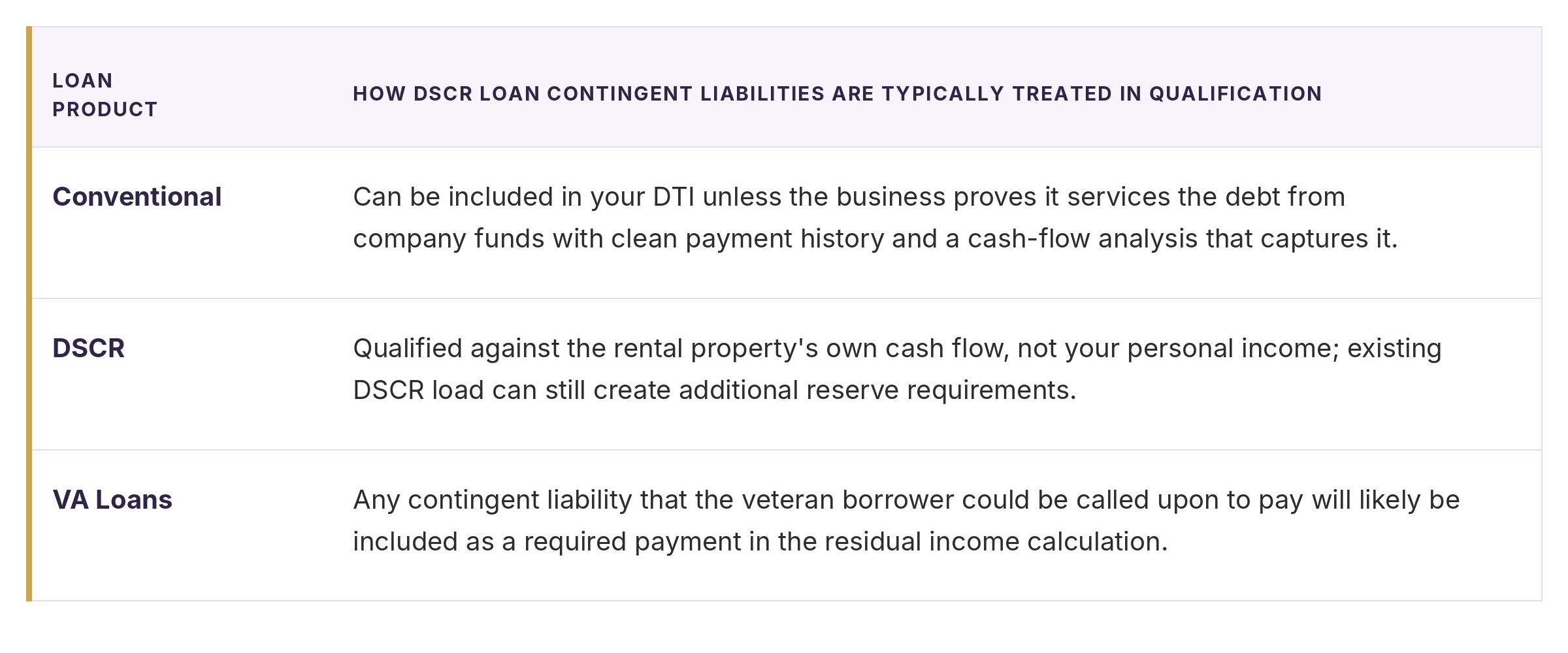
How each loan type typically treats a DSCR loan contingent liability.
You need to have an upfront understanding of how a DSCR loan to your entity will impact future loan programs before you move forward. That conversation belongs on the front end, with a lender who can explain the specific details - not as a surprise after closing.
What This Means for Your Next Purchase
The honest version of the story about DSCR loans to your LLC is more useful than the myth. Yes, your entity-held loans keep your personal credit report clean, and that's a real advantage. But the same structure creates documentation and liabilities that a diligent underwriter will find, and it may carry a legal duty to disclose on many loan applications. Treat any personally guaranteed debt as real in every future application - because to the lender, it could be. Plan your borrowing around the debt rather than hoping it stays hidden, and you protect the capacity you have instead of gambling it on a concealment that can end in fraud.
Next Steps
If you're considering a DSCR loan to your entity and want clarity on the impacts of contingent liabilities, schedule a free loan consultation with me. I'll walk you through what to consider.
Related reading: One Deal, Three Quotes | Investor Resources
This article explains how contingent liabilities can affect loan programs. It is educational content, not a rate quote or a commitment to lend. Loan terms vary by lender and borrower qualifications, and I do not quote rates, fees, or return figures here by design.
Sources
[1]singlefamily.fanniemae.com/media/17391/display
[2]selling-guide.fanniemae.com/sel/b3-6-01/general-information-liabilities
[3]selling-guide.fanniemae.com/sel/b3-6-05/monthly-debt-obligations
Roberts Lending Group, powered by Home Loans Inc
Patrick Roberts | Mortgage Loan Originator | NMLS #2482096 | Licensed in SC, NC, and LA
Home Loans Inc | Company NMLS #1728740
2557 Ashley Phosphate Rd, North Charleston, SC 29418 | Equal Housing Opportunity
loansbypatrickroberts.com
This content is for educational purposes only. It is not a rate quote, loan offer, or commitment to lend. Loan products, terms, and availability vary by lender, borrower qualifications, and property, and are subject to underwriting approval. Home Loans Inc is a mortgage broker, not a direct lender. Not all products are available in all states. Verify our licensing at NMLS Consumer Access.
© 2026 Roberts Lending Group. All rights reserved. | Privacy Policy | Contact