The short answer: most investment property lenders accept cash that is clearly yours: savings, liquidated investments, and money borrowed against an asset you already own. Most won't accept cash they can't trace, unsecured personal loans, or (on conventional loans) gift funds. DSCR, bridge, and private lenders largely make their own rules, so the real answer depends on the program and the lender.
Conventional loans are the most standardized and the strictest about sourcing, because they follow Fannie Mae and Freddie Mac guidelines. DSCR programs vary by lender but still verify your cash in most cases, with many following Fannie Mae guidance. Bridge lenders usually have lighter documentation requirements, and private lenders decide for themselves.
Key Takeaways
Sourcing is proving where money came from; seasoning is how long it has been in your account - most lenders will allow cash that's been in the account for long enough.
Your savings, borrowing against another asset, liquidated investments, sale proceeds, and retirement accounts are usually allowed.
Unsecured personal loans, credit card advances, and untraceable cash are usually disqualified for Conventional and most DSCR programs.
Gift funds aren't allowed for Conventional loans, but some DSCR programs allow them with conditions. Seller credits are usually limited to 2%-6%.
Institutional fix-and-flip lenders vary on what cash they allow, while most private lenders have their own internal rules (or none at all). Generally, rules vary by lender in this space.
Allowable cash isn't just about your down payment; it includes cash for closing costs and reserves as well.
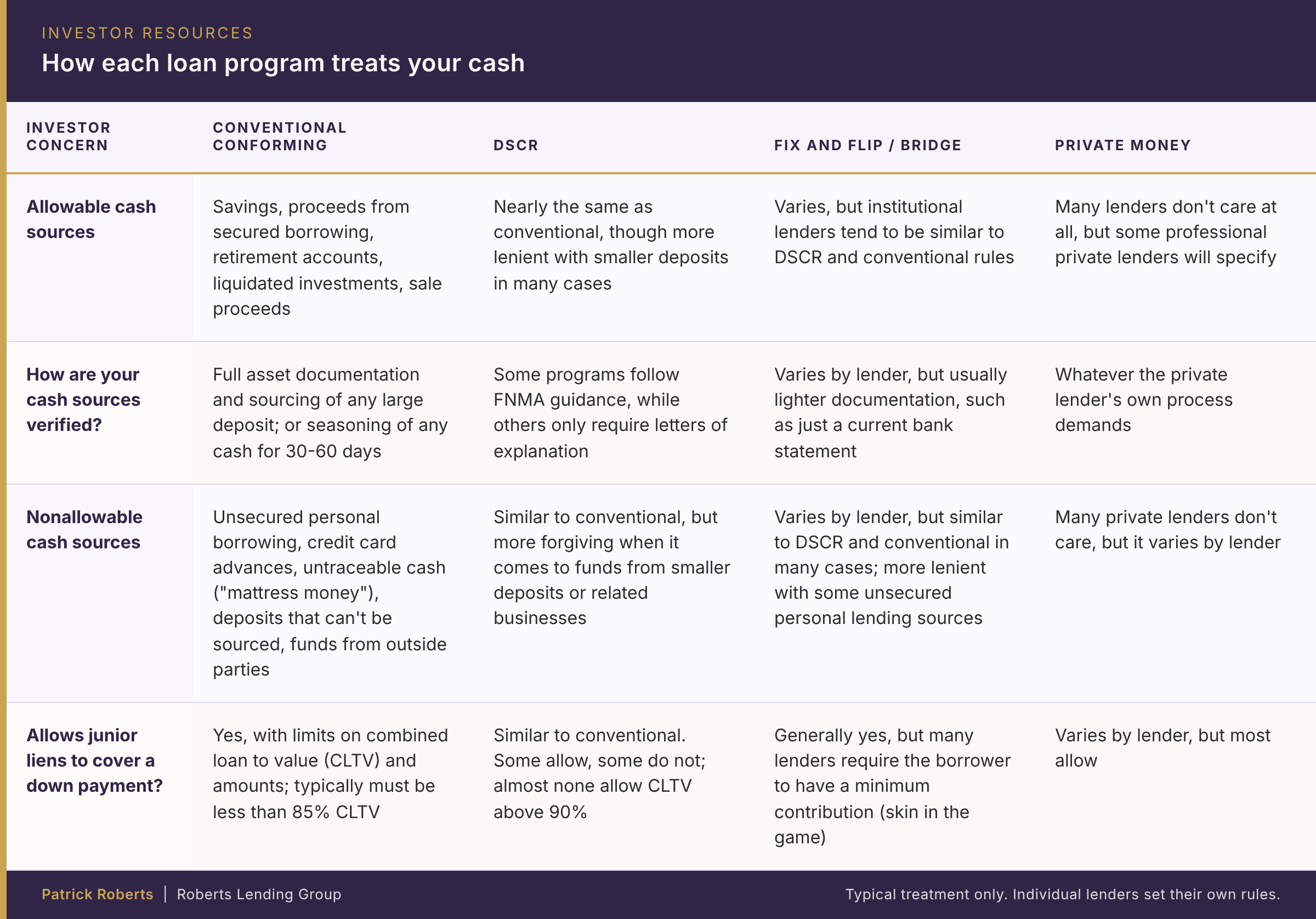
The quick comparison: what each loan program checks
The table below shows typical treatment, but is not set in stone. Individual lenders set their own rules, especially on DSCR, bridge, and private loans.
This is an educational overview. Guidelines change, and every lender sets its own requirements.
Sourcing vs. seasoning: how lenders verify your cash
Every lender qualifies your cash based on one of two things; whether it's seasoned or can be sourced. Sourcing is documenting that the money came from an acceptable source - a paycheck, a HELOC draw, a 401(k) loan, a sale of securities. Seasoning applies to how long it has sat in your account. Generally, sourcing isn't required when cash has sat in your account for a sufficient amount of time - it's deemed to be seasoned and therefore allowable.
Most lenders review account statements covering the past 30-60 days to determine whether your cash for closing is seasoned or needs sourcing. Cash that has been in the account for the required period ("seasoned") is usually allowed without further documentation. Cash that was deposited into the account during the period in question, whether by transfer, check, or some other method, will have to be sourced.
A hypothetical example
An investor sells some securities in a brokerage account to cover the cash to close on a new property and sweeps the funds into their bank account two weeks before applying for a loan. During underwriting, the underwriter sees only a large, recent transfer into a bank account on the statement. After receiving the investor's explanation, the underwriter requires the brokerage transaction statements that show the securities sale and the transfer. Because the cash wasn't seasoned (the money had been in the account for only a few weeks), the underwriter sourced the cash, verifying that it was from an allowable source.
Such a large, unexplained deposit is a red flag in conventional underwriting. Fannie Mae's selling guide[1] treats deposits above 50% of your monthly income as a sourcing trigger; you will be required to prove where the money came to determine whether it's allowable. Many DSCR lenders have similar rules for deposits: large deposits (typically around 5% or more of the deal or those over a certain dollar-size) may need sourcing or a signed letter of explanation. In most cases, small deposits are ignored unless other evidence or patterns are present.
Cash sources lenders usually allow
These represent generally acceptable sources, so they clear underwriting on nearly every program.
Personal savings and checking balances. Seasoned cash is the default. Its source is rarely questioned.
Cash-out against an asset you own. A 401(k) loan, a Heloc or Equity loan on another property, a loan against life-insurance cash value, or a brokerage margin line count as secured funds. Most DSCR lenders accept borrowed funds secured by an asset; Fannie Mae lists them too.
Liquidated investments. Selling stocks, bonds, or mutual funds is a clean, traceable source. When not yet liquidated, most lenders count a percentage of the account value.
401(k) and retirement accounts. Vested money works on conventional, and DSCR lenders typically allow at least some portion. Most treat a percentage as eligible, but some lenders will require your plan documents to determine whether a withdrawal is allowed.
Sale or refinance proceeds. Cash from selling an asset (like another property) or from a cash-out refinance loan of another property is usually allowed.
Cash sources that are rarely allowed
These usually fail because they're cash with no verifiable trail, and they create risks like a borrower being undercapitalized, or possibly even money-laundering.
Unsecured personal loans and credit card advances. Using these instruments as cash to close is a second loan on top of your mortgage - replacing presumed equity with more debt. Fannie Mae has explicit rules for these, and most DSCR lenders don't allow them; however, some fix-and-flip lenders will allow these loans.
Untraceable cash. Physical cash kept in a home safe (often called "mattress money"), undocumented side-job cash, or deposits with no paper trail don't survive asset verification. If a lender can't see where it came from, they usually won't allow it.
Undisclosed debt. A deposit tied to a loan you didn't disclose - such as money borrowed from a friend that you've agreed to repay - is treated as unsecured debt and usually won't be allowed. Trying to sneak debt past the lender can land you in serious trouble for mortgage fraud with some loan programs, such as Conventional loans.
Every program still documents your cash and reserves; "no money needed" is mostly a myth, especially on DSCR loans.
Where rules vary by program
These are where the programs genuinely disagree - where funds disallowed by one lender are acceptable to another.
Gift funds. Conventional loans don't allow gift funds on investment property purchases. Some DSCR loans allow gift funds, usually with a minimum contribution amount required from you (usually 10%+ of your own funds), with the donor having some kind of relationship to the borrower. There are usually LTV restrictions with gift funds, and some DSCR programs don't allow them at all.
Seller credits. A seller credit lowers closing costs but doesn't count as your down payment - it applies to eligible costs and won't replace your required equity. These are usually capped at 6% or less of the purchase price (or a fixed dollar amount). This varies heavily by lender for DSCR loans, while Conventional caps these at 2%.
Business assets. Cash from business accounts can cover the cash to close in many cases, but there are often limitations. Many DSCR lenders require you to own a certain percentage of the business, and some require a cashflow analysis or accountant's letter showing that taking the cash will not hurt the business. Conventional lenders accept business assets with heavier documentation, and for self-employed borrowers the business cash flow review usually already includes a liquidity check.
Funds held in an LLC. If an entity will own the property, that entity's funds are usually allowed, but most DSCR lenders require the funds to be either seasoned or sourced. Many fix-and-flip lenders are less concerned about this. Moving seasoned cash between your personal account and the entity is usually fine.
Crypto and foreign assets. Increasingly accepted on DSCR, but only after liquidation and transfer. Most require crypto to be deposited into an established U.S. bank account and counts a percentage of its valuation; foreign funds must sit in a U.S.-domiciled account in your name for a certain number of days before closing.
Second liens on the property you're buying. Some programs allow subordinate financing (such as a seller carryback note) as part of the down payment, with limits on combined loan-to-value. Others don't. This is different from borrowing against a property you already own.
Buying in Louisiana: how community property affects your cash
Louisiana is a community property state, and that can change how a lender looks at your cash and who needs to be involved in the loan. Generally, money either spouse earns during the marriage is community property, and property acquired during the marriage is presumed to be community unless it's shown to be separate. For married investors, three questions come up most often:
Whose money is it? Funds in an account titled to one spouse may still be community funds. If the account includes someone who isn't a borrower, a lender will often ask for a signed letter from the spouse confirming you have access to the funds. Discussing this before you apply is easier than during underwriting.
Who has to sign? On a conventional loan, a spouse who isn't borrowing and isn't on title generally does not have to sign the mortgage or deed in Louisiana. DSCR lenders set their own rules, and many ask the non-borrowing spouse to sign a form acknowledging the new debt and pledge of the property. Ask your lender and your closing attorney early. This can also apply to entities domiciled in community property states.
Does separate money need to be documented as separate? If you're using money you consider separate, such as an inheritance or savings from before the marriage, the way it's documented and stated on the purchase documents can matter. That is a legal question, so confirm it with a Louisiana attorney or your closing attorney before you buy.
I'm a lender, not an attorney, so treat this as a list of questions to ask rather than legal advice. The practical takeaway is simple: in community property states, there may be additional requirements.
Cash to close vs. reserves
Allowable cash isn't only about your down payment. It covers the down payment, closing costs, and the reserves you maintain after closing. Reserve requirement often surprise most investors. The same sourcing and seasoning logic applies, so money a lender can't verify can't serve as reserves, even if it's sitting in your checking account. Requirements vary by program and by how many financed properties you own, so ask for the reserve requirement in writing before you plan your cash. My free guide, 5 Action Items If You Plan to Get an Investment Property Loan This Year[2], covers this in more detail.
How lenders actually verify your cash
The mechanics are the same across programs; only the depth changes. Every lender needs to see that the money is yours, accessible, and there is enough to close. Lenders generally prefer third-party official documents where possible, but there are many ways to verify cash sources.
Account statements. These show the institution, the account holder, the account number, the date, and the statement period. The period they ask for varies by lender.
Transaction documents for large deposits. A brokerage transfer, a 401(k) loan, or a bonus is backed by its own statement, records, or paystubs. Sales of assets, like real estate, are proven through settlement statements or Closing Disclosures. Large business account deposits or checks are commonly backed by invoices, POs, or receipts.
A letter of explanation. If a deposit looks unusual, you may be asked to explain it in writing. If you can't explain it and document it, it generally won't count. A gift, where allowed, needs a letter naming the donor, the amount, the date, and that no repayment is expected.
What each program wants from your cash, specifically
Once you've picked a lane, the documentation demands differ.
Conventional. The strictest and most standardized on sourcing. Deposits and assets are verified under Fannie Mae and Freddie Mac guidelines, gift funds are not allowed on investment property, and qualification rests on your personal finances, so expect a full review of your assets.
DSCR. The rental income qualifies the loan, so the lender cares less about your income. Most DSCR lenders still require full asset documentation, and they want to see that all of the debt payments associated with the property are being captured. Using additional, undisclosed debt could mean you're manipulating the true DSC ratio by borrowing elsewhere under the radar.
Fix and flip / bridge. Underwriting centers on the after-repair value and your exit, not personal affordability. Documentation is usually lighter, but most lenders still confirm real skin in the deal and that you can cover carrying costs. "No money needed" is a largely myth, and inexperienced or first-time investors should expect stricter requirements.
Private money. A private lender underwrites to its own rules, so required documentation can be the thinnest or the most opaque. Ask what's allowed before committing time or effort to the deal.
Frequently asked questions
Can I use money from stocks I just sold as a down payment? Usually yes. Expect to provide brokerage statements showing the sale and the transfer into your bank account.
Can I use a HELOC on my primary home or another rental for a down payment? Often yes. Borrowing against real estate you already own is generally an acceptable source on conventional and most DSCR loans. On conventional loans, the HELOC payment generally counts as debt, which impacts your DTI. This usually doesn't apply to DSCR loans.
Can I use a 401(k) loan for a down payment? Often yes, as borrowed funds secured by an asset. Your plan has to allow the loan, and the lender will want the loan terms and proof of transfer. Many lenders also allow retirement funds to be used as reserves.
Can I use cryptocurrency toward a DSCR down payment? Many DSCR lenders allow it, but typically only after the crypto is liquidated and moved into an established U.S. bank account. Lenders often count only a portion of the crypto balance, so don't plan on the full amount.
Is it ever acceptable to use a personal loan for my cash to close? Rarely. An unsecured personal loan is borrowed money, not your own equity. Conventional underwriting doesn't allow it, and neither do most DSCR lenders. Some bridge and private lenders will, so it varies by lender.
Can family gift funds be used on an investment property loan? Not on conventional loans. Some DSCR programs allow gifts for part of the down payment and closing costs, usually after you contribute a minimum from your own funds, and the donor must have a qualifying relationship to you. Others don't allow gifts at all.
How long does money need to be in my account before I apply? It depends on the lender. Conventional lenders typically review the most recent two months of statements. If the cash lacks seasoning, you'll usually need to show where it came from. Ask your lender about seasoning requirements.
Can I use my LLC's or business account for the down payment? Sometimes. Lenders usually want to see that you own the business, and some ask for an accountant's letter or conduct a cash flow analysis. Ask early, because the funds may not be usable if taking them would adversely affect the business. This applies to businesses that are not a party to the new loan. If you're using a business/entity to buy the property and get the loan, then that entity's cash is usually allowable without restriction, so long as it's either seasoned or sourced.
Not sure which how much cash you'll need for your deal?
Schedule a free call with me. We'll review your deal - your property numbers, your cash position, and the plan - and we'll walk through how each program would treat your sources of funds. No pressure to commit to anything.
Citations (2 sources)
[1]singlefamily.fanniemae.com/media/48241/display
Roberts Lending Group, powered by Home Loans Inc
Patrick Roberts | Mortgage Loan Originator | NMLS #2482096 | Licensed in SC, NC, and LA
Home Loans Inc | Company NMLS #1728740
2557 Ashley Phosphate Rd, North Charleston, SC 29418 | Equal Housing Opportunity
loansbypatrickroberts.com
This content is for educational purposes only. It is not a rate quote, loan offer, or commitment to lend. Loan products, terms, and availability vary by lender, borrower qualifications, and property, and are subject to underwriting approval. Home Loans Inc is a mortgage broker, not a direct lender. Not all products are available in all states. Verify our licensing at NMLS Consumer Access.
© 2026 Roberts Lending Group. All rights reserved. | Privacy Policy | Contact